Tuesday, September 30, 2014

Audio Video Short


In the time I've spent around the world, I've developed a small obsession with street art, and have constantly been amazed by the sheer lack of it here in the United States. Though there is plenty on the streets of New York, it is not as much an open part of our culture as it seems to be in other countries. Particularly notable in Chilean and Greek artists, street art fills a space of silence in a modernized world. Whether it serves to help rally against a dictator, to reclaim a 'homeland' or merely express an artistic craving... art is an evolutionary act. 


Expression is natural, concrete is not, by Mobstr. And that completes today’s selection of street art quotes!


Check out the Global Street Art movement's blog to learn more. 
Enjoy!


Monday, September 29, 2014

McCloud 7-9, Wolf, Mishra


It seems the theme of the week seems to lay here:  instead of here, in the words... Though from the McCloud reading last week, I'm not so sure the two are drastically different. Wolf brought to the conversation the idea of computer simulation, and the effect of images (and their validity) on human interpretation. She surmises: "Computer simulation's speculative nature blurs the lines between fiction and nonfiction a complicates the question of how far an indexical link can be stretched and displaced and still be considered valid in society, as facts get skewed, left out, misinterpreted, or filled in by theory and speculation" (Wolf 429). In particular, she mentioned that in court, often black and white images could be references but color images were thought to sway the audience. If this theory is accurate, then does color make a difference here too? Immediately our eyes are drawn to color, and naturally we are more apt to remember something that is distinct like the above phrase. But why is it then that we don't see more freedom of 'manipulation' in the ethos of traditional writers? Think of almost every book you've ever read- can you think of one that was not printed on ivory paper with black or greyed ink? Why as writers, are we not able (or not willing) to play into the tools we are given?

**When I google searched this, I found absolutely nothing- no discussion, no forum, no other contemplation of why this happens to be the case. Though I feel it may have originated as an economic decision, and of course has its historical contexts (because printing is expensive) but I can't help but ask- haven't we evolved past that yet?

Color in photographs is one of their main attractions, and artists avidly use this to distinguish their work from other artists. McCloud talks about the flagrant use of color in comics, and from his chapter 8, it is easy to see the moves that color can make for that industry. I think back now to hyperreading, and wonder if the use of color and the heightened sense of freedom in format has anything to do with this generations tendency to prefer online media versus book in hand. Would this pattern change if we incorporated more technique associated with these mediums? 

Friday, September 19, 2014

McCloud 1-4

Who knew comics were an art? Not this girl. As 'graphic novel virgin', the first time I'd ever read anything besides the Sunday Funnies was in Amy Thomas' class, Literature Unbound, where we critically looked at The Walking Dead- in both it's television and (original) graphic novel forms. Talk about inter-texuality... For her class, we also read from McCloud to help us gain a general sense of, really, what's behind the art of comics and graphic novels.

One of McCloud's biggest points of focus lies in the differences between Eastern and Western comic design and the shifts in the artistry and design, and how that changes the way the reader perceives the finished work. He makes a point that Japanese comics are heir to a tradition where "they emphasize being there over getting there"(McCloud 81). I try to translate this into my work as a creative-minded writer, and think about ways in which I may tend to focus on the 'getting there' of a story, over, perhaps, the element of 'being there'. Something that comes to mind (since we always go back to what we know) is Virginia Woolf and her novel, Mrs. Dalloway. As many of you are familiar with her work, I'll skip the summary (you can find it here if you find yourself ignorant), but the book tells a story that takes place in a single day- a very narrow time frame (much like we see in Joyce's work, and other stream of consciousness-esk writers). Within this tiny time frame, I imagine that Woolf was forced quite often to ask herself this same question of where her text takes the reader- and in this instance, I see a crossing over of both the East and the Western ways of thinking (or so they call Modernism). 

Going back to Porter's essay where he mentioned that "writing is non-linear", I think comics really lend us a sense of that. Not a 'classical' form of literature, where we may read left to right and focus on only the prose on the page, comics ask more of us as an audience as well as a writer. Just look at their versatility! From graphic novels to political statements, humorous or tragic, they build relationships in very tangible ways, making the reader, arguable more loyal, to the source. Just think about Garfield, Charlie Brown, or X-men... comics are able to fill a gap that prose alone cannot. 


 They are a great medium through which we can further our understanding of 'texts' outside of the traditional sense. I'm not sure before my experience with McCloud, and his expression of the craft that goes into this form of literature, I would have been tempted to pick up a graphic novel. Knowing what I know now, about the level of interaction between author and audience, and the inevitable vulnerability of a comic writer, I am much more interested in the genre as a whole. I think it is incredibly important, now more than ever, to keep looking across genres and asking ourselves (especially as writers) 'what can this do for my work?' How can lessons in comics translate into lessons in literature? And in what ways can I pull on the things McCloud is saying, like the blood in the gutters (or the formatting, ie. breaks in between chapters, paragraphs) to further my view of writing as a whole?  

Monday, September 15, 2014

Sosnoski, Jakobs, and Hayles

Hypertext.
As I sit and type, I am thinking about how this very action can (if it does) differ from constructing prose, pen and paper in hand, in the 'traditional' manner of writing.  Do we see the same cross over from Hyper-writing, if you will, impacting traditional writing skills? Is this a natural correlation to make if reading skills are in a (supposed, according to Hayles) decline due to Hypertext/reading?

Sosnoski talks about computer-assisted reading, and renders it somehow different from reading that same text in a printed version. Putting his essay in conversation with Hayles, we begin to understand why these two mediums differ. Hayles claims that Hyperreading actually require changes in brain architecture (67), in addition to adaptation to new reading strategies that Sosnoski points out; filtering, skimming, pecking, imposing, filming, trespassing, de-authorizing, and fragmenting (163).

It is arguable whether or not these new skills required for Hyperreading are in direct opposition to close reading. I find myself often in the position in a college semester, where I simply do not have to time allotment for the reading I need to do. In these instances, perhaps due to my experience with Hypertexts, I can use my adapted reading abilities to skim and peck the texts and still come away with a general understand of a text- still able to put it in conversation and learn or benefit from the discussion. I think the contingent issue at hand is not the use of these new skills, but the perpetual use of them.

Students in generation X are resourceful, as well as lazy. I have friends who 'hate to read books'- perhaps because they struggle with the restricted and academic format, and perhaps they take more easily to the flexibility that can be found in Hyperreading. But take caution, the internet has opened up a world of quick-fixes and easy solutions, like websites that will actually write your essay for you  (http://www.essaywritingsoft.com/essay-generator.html ) or translators that make it possible to read a novel in Spanish while not comprehending the language. In our world today, there is no offline. We are constantly connected, perpetually plugged-in, and watching our trends of modernization, we won't be slowing down anytime soon. Not all hope is lost, though. The Atlantic found an interesting trend between number of books read and level of education, showing that on average, Americans in college read 9 books per year. What their study fails to differentiate is if these books were read with the aid of a Nook or Kindle (Hyperreading?) or were traditional novels in print. Check it out, and think about what Sosnoski or Hayles would have to say-- Jakobs would probably spiel about the webpage's setup.

So as Hayles proposed, we need to stop haranguing Hypertext and asserting that deep reading Joyce's 'Portrait' is the only way to identify well constructed prose, and begin to look for ways to combine and better navigate a combination of Hypertext and close-reading, so future generations can remain balanced and evenly skilled. Hayles surmises: "The larger point is that close, hyper and machine reading each have distinctive advantages and limitations; nevertheless, they also overlap and can be made to interact synergistically with one another" ( 75).

I'd like to state that I found Jakobs essay dry and virtually useless, focusing too much on teched-out language and forms that are not easily relatable or even understandable to the average reader.
Not a fan- I'd argue we could drop this from the readings the next go around and be no worse off, though I'd like to see how others react to this work, since we all have our preferences...

Monday, September 8, 2014

Wysocki-Eilola, Fisher

(Imagine more creative title here)

    I enjoy very much that Fisher grapples with the idea that technical reason renders the public unreasonable (392) and that knowing 'rational discourse' could potentially shift ones position in society- or the unfortunate contrast of constantly segmenting people into distinct classes (those who 'know' in terms of specialized discourse, like a community's understanding of politics, and those who 'do not know').
    This in particular I found this to communicate well, in limited ways, with Wysocki et al.- though I think we better converse with Wysocki to understand literacy's shift in priority in American culture. The authors dare to provoke the reader to ask: why is literacy so important? To which they go forth boldly and claim:
       "In the United States, we live the mythology of a classless society... In a society bound by such a mythology, our views about literacy are our views about political economy and social opportunity..... Far from engineering freedom, our current approaches to literacy corroborate other social practices that prevent freedom and limit opportunity" (Stuckey vii) (Wysocki et al 354).
Perhaps this importance that has held on to the coattails of the word 'literacy' for so long should be re-purposed, or rather the constitutes in which we understand this discourse needs to be radically shifted. The authors here argue that the paradigm in which we operate as post-modern and technologized (yes, I've made up a word- I'm a writer- I can) human beings has skewed our sense of priority or importance in a world that is now based on progress. As we move with the ever-changing times, I feel the need to ask- is a separation like this, where one class is privileged and one marginalized, anything but sequential?

    As we look back through our history, we can continually see a gap expand between those who are educated- literate- and those who are not. It is not shocking to hear that the literacy levels trend alongside of elevated wealth, which then naturally coordinates with higher social standing. I can only assume, as Wysocki suggests, that our priorities began to shift with the erasure of the first maps and Colonization gave birth to Progress and Modernity.
How quickly we forget our roots. Throughout time, humanity has proven to be interested in engaging with history, fiction, depiction, art..."Man is both in his actions and practice... essentially a story-telling animal"(201)(Fisher 375). Through these stories, we have an opportunity (for those fortunate enough to be literate) to share our lives. We are able to have an immortal voice, and create even a world that is better than our own. I cannot help but be reminded of the incredible story one woman has to offer us, speaking out in a courageous voice that, before her, had been silenced by the thousands.

   The book and autobiographical memoir I, Rigoberta Menchu: an Indian Woman in Guatemala is a retelling of the lifetime of an indigenous Quiche Mayan woman and her family in Guatemala during the military regime. Menchu grew up working her family's antiplano in the mountains, but when their land was disputed by the military, she and her family were forced into working on the coffee plantations where the indigenous were exploited for labor, abused and underpaid- if paid at all. Her father, an advocate against the government, was burned to death by an opposing political party and her brother was publicly tortured and killed by a military firing squad. Her mother- kidnapped, raped, mutilated and then murdered- suffered an equally unjust fate.
    After spending time in hiding (and eventual exile) in Guatemala, Rigoberta, when she was 23 years old, taught herself Spanish so she had a means, a voice at last, to communicate her story and her family and tribe's suffering to the rest of the world. She found a translations expert and dictated her story in her limited Spanish, which was then translated to English and published worldwide. Though she was not literate in the modern sense of the word, it was, and is still language that gives her the freedom she and her people deserve.
In 1992, she was awarded a Nobel Prize "in recognition of her work for social justice and ethno-cultural reconciliation based on respect for the rights of indigenous peoples" (nobelprize.org) 
To learn more, please watch: (Keep in mind the difficulty of translation and that even Spanish here is not her native language) https://www.youtube.com/watch?v=Irvq1CHPAvo

*Though you can skip to Rigoberta at 3:30 (or 7:10 to get past the thank-you's), the introduction is a nice word on the importance of language as a voice for the silenced and marginalized. 

Tuesday, September 2, 2014

Welcome to my bedroom

 I had this great aspiration to film my video from the back of my horse, or on a mountaintop, or underwater... but then I decided why not in my bedroom? If this is truly to serve as a "get to know you" video, then where better to know me than in my most intimate space? We surround ourselves in our homes with little things that help define who we are and what we value- in my room there are my maps, photos of horses, rivers and friends, and small objects that help me remember where I've been and what experiences have made me who I am. Whether it's a mortar and pestal gifted to me from mi familia in Chile, or a framed photo of my boyfriend and I on horseback in the Crazies- it's all a part of my internal makeup and contributes to who I am in some way or another. So here you are, as simple, raw and real as can be. 


Monday, September 1, 2014

Fish, Porter, Grant-Davies and Whitacre- Week 1

I'm fascinated by Porter's claims- his bold, uninhibited separation of writers and readers, and the inversion of this relationship on which we are so reliant as authors. Grant-Davie was less... entertaining, though he backs up Porter's claim (intertexuality, anyone?).

Grant-Davie asks "What is the discourse about?", or more effectively, "what values are at stake"? By asking this, we are introduced to Porter's hypothesis of inter-textuality, and the constrains of the audience, or Text, limiting the writing. As Porter states, " genius is possible, but it may be constrained" (Porter 40). We examine the place of the writer within his community, and now the community's manipulation of the writer's product.
I particularly enjoyed his claim that we should revisit the very idea of plagiarism, and possibly redefine it's parameters to include "borrowing" from our chosen discourses.
Why is this applicable? Why should I care?
Porter might argue that our nation was founded on a plagiarized document. Jefferson's accredited Declaration of Independence was indeed drafted from legislative inspiration of the mid 1700's, and Porter even argues that 'life, liberty and the pursuit of happiness' was a common cliche of the times. I can't help but think, are turns of phrase all intended to be coined? Can an author claim stake to every series of words he produces? Does this mean we cannot ever truly create anything new? How are we to understand proverbs in this light?
Despite some initial skepticism, Porter's point asks us to reevaluate our own position in the relation between author and audience, rhetor and discourse community (or Fish's interpretive community, Grant-Davies inter-textual social community) and see that intertext in fact 'constrains writing' and therefore the author as well. He argues that students should learn from none 'heroic' role models who borrow from their discourse communities to better learn how to become a contributing writer in whatever field, or discourse community, that they choose. He wants us to understand that as writers, we are operating in a paradigm that "cultivate(s) the romantic image of the writer as free, uninhibited, as independent creative genius" (Porter 34), and that instead, it is the very community in which we work that should be our focus.
In essence, we, as writers/readers/consumers of literature and writing in its more interpretive forms, are entering an ever changing paradigm- a world in which boundaries and previous notions can no longer be set in stone. This brings me to several curiosities: What is our purpose, now in the height of modernity, to be taking this class?  What discourse should we understand ourselves in, and are they different for each of us?

Porter also mentions that 'writing is non linear' which I couldn't help but understand in terms of the TED talk in class, and Erik Whitacre's virtual choir, and the mediums through which he used prose- in the most nonlinear ways. Attempting to redefine our more classical (or limited, linear) understandings of relationships, (i.e: prose/audience, rhetor/rhetorical situation, plagarism/inter-textuality) can cause us to stretch past what we have always understood to be 'true' (or existent as Lizzie pointed out in her blog post) and create something new, something genius, something that may even end up becoming the unaccredited 'Once Upon a Time' of our time.


Saturday, August 30, 2014

Hello 371

Yes, I've reduced you all to a number. Class number 371, to be more specific. By senior year, any 'first day' jitters have far been done away with, and I'm left more with a general curiosity about who hides behind the screens of our classroom.

I generally sit in the front row, next to Sicily and another classmate, who, by his browsing trends I assume to have a relatively short attention span. I don't know your name yet, but give me time : )
Isn't it odd how almost all of us revert to the same seating patterns after that initial day of class? If I sat in the back row would it throw off Kelsey's chi? Or would anyone even notice a simple brunettes' shift of space?

I suppose I'm ahead of myself.

 I'm Lea, a double major in Environmental Study and English Writing, though those are just words that will roll over you. I spent a large portion of my time in South America, studying a river system in Patagonia facing severe environmental degradation due to Goliath, HidroAysen, an international mega-corporation pushing to construct five hydroelectric dams on the most powerful and most ancestral rivers in Chile.

This, and other water rights issues, dominate my mindset 97 percent of the time.

The remaining three percent of capacity seems to love doing extreme sports on horses, travel, red rock, tea and Edward Abbey, mountaintops, indelicate things, and the way the sun feels on my skin as it filters through the fingers of a Pine still draped in Montana dawn.

Ask me anything, I'm an open book.

The Walking Dead: other repetitious patterns in literature ROUGH DRAFT

Contrasting The Simpson's Treehouse of Horror and The Walking Dead t.v. series at first seemed... unconventional, to say the least. Being a fan of neither show, nor particularly keen on the latter's subject material, I can't say I held high hopes. As with most things though, I was pleasantly surprised.

The Walking Dead:
- Follows classical trends of Joseph Cambell's the Hero's Journey
     Rick; protagonist, sheriff, ---> "hero"
     Laurie; wife, mother, ---> "damsel in distress" (important to note she is the only female character we are introduced to in this episode)
     Shane: adulterer, protector, ---> "villain"


Important to note that the whole series will probably follow this ark, though each individual episode can see some crossover and continues building on the reoccurring themes. Can we imagine this picture to be anything but a circle?

2nd episode: would it be considered looting? Questioning of morals, Rick "don't think those rules apply anymore, do you?" Tug-o-war between tradition and modernity
binary between right and wrong, good and evil, us and the other? brings into question the very idea of our humanity, (id from dead zombie, crossing his chest saying oh mios dios, still reaching out for human connection or explaination higher than ones self) where are the boundaries of this new world? Capacity for forgiveness (handcuff and key on rooftop, racism)

The Simpsons:
[seems to] follow creative writing's 'story telling curve' in three mini-episodes
Lot's of parody and surprising number of literary references (ex: Hitchcock, Shakespeare, Night of the Living Dead, Nightmare on Elm Street, Creature from the Black Lagoon)


Sunday, April 20, 2014

Patagonia Sin Represas


 I copy out mountains, rivers, clouds.

Welcome to Patagonia, Chile. Geographically, the 11th region- Aysen XI- of Chilean Patagonia, home to no more than 4,000 people in 42,095 square miles. To the north lie the Northern and Southern Icefields, and to the south, Antarctica. On a map, the west is marked by the flood of the Baker river's flow into the Pacific Ocean, and to the east, the Argentinian boarder. 
This is the wildest place on Earth.

I take a pen from my pocket. I note down

The people who call Region Aysen home are proud, genuine people. They spend their days simply, sunset to sunrise in the harshest environment on Earth. They love their mountains, their rivers, their forests because they understand that these are their livelihood. They celebrate each day with bread and wine, of which they find it impossible to overindulge. They are the most generous group of people I've yet to know. 

a bird in it's rising 

The small farms that speckle the landscape are duro, strong, like the hardened hands that have worked their familial lands for years. They've roped and wrangled this turbulent earth until they know exactly how it feels, stained like blood on their palms. 

Or a spider in its little silkworks.

Livestock have become a precious thing, always in constant battle with the unbridled elements- pumas, earthquakes, the never ceasing-winds. Farmers are finding it more and more difficult to maintain their traditional lifestyles in such isolation. Yet, they choose to remain.  

Nothing else crosses my mind. I am air, 

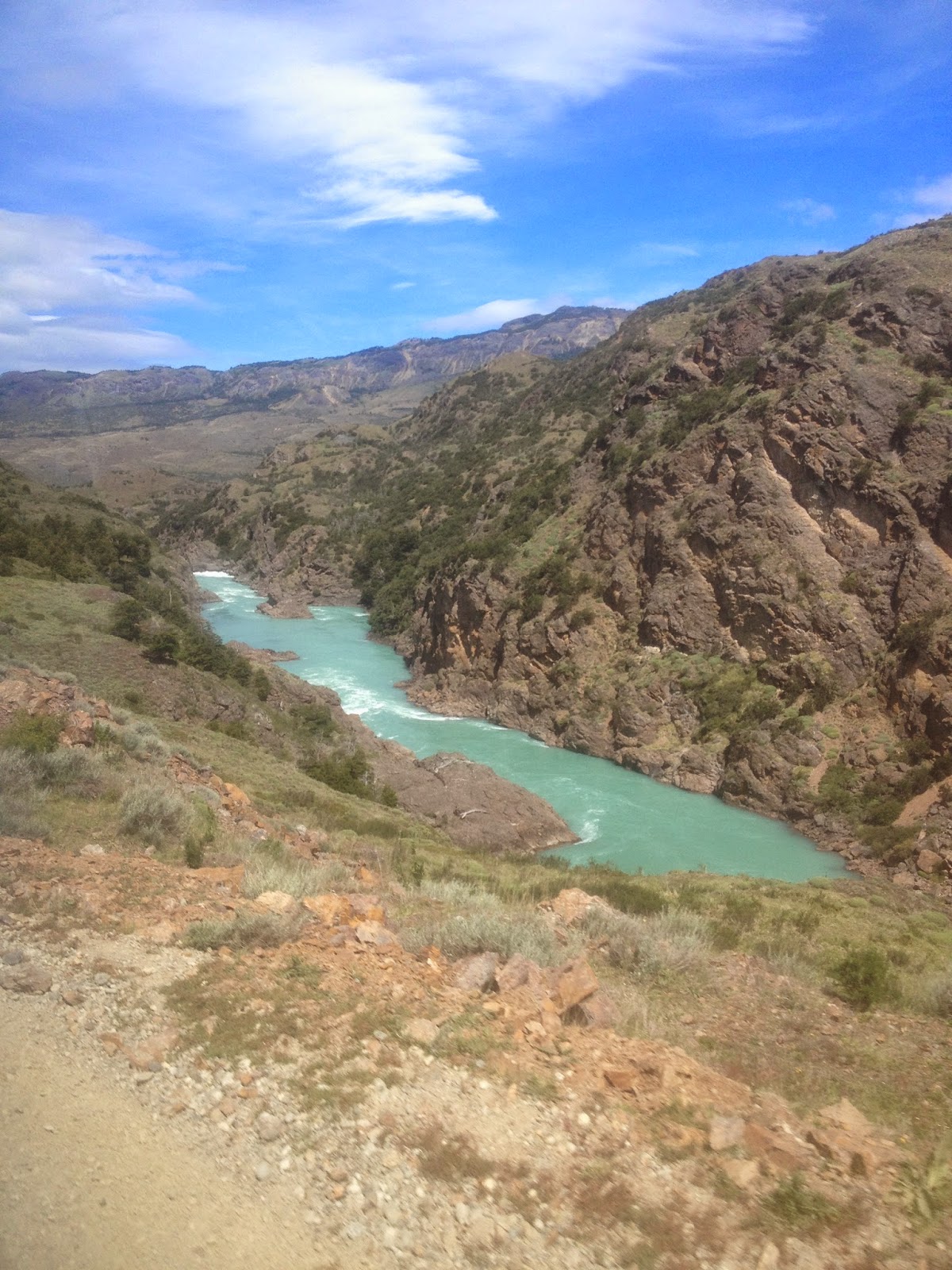
The river is their lifeline. The ancestral Baker river, the most powerful of all of Chile's water sources, runs south 170km from the east at the Argentine boarder. The Baker is the heart of Aysen, providing jobs and unaltered beauty to those lucky enough to call her banks home. The river is a mirror reflection of it's people: strong and running free- for now. 

clear air, where the wheat is waving 

Maykol and Luis operate a rafting outfitting service on the Baker. They run some of the rapids four and five times a day, discussing eagerly afterwards in excited Chilean slang how they can improve the ride. When the boat is packed up and wetsuits have been shed, they make sure the thank the Baker, both closing their eyes for a minute as they emerge dripping in turquoise water, knowing their free spirits would be lost without this river. 


where a bird's flight moves me, the uncertain


fall of a leaf, the globular

eye of a fish, unmoving in the lake 

In the 1970's under the military dictatorship of Pinochet, Chile lost national control of most of its resources, including water. The privatized companies that now control Chile's rivers span across continents. The United States hold rights to six rivers, triumphed only by Endesa, a company from Spain that has collaborated with Enel from Italy to create a mega-corporation: HidroAysen. They plan to build a series of five hydroelectric dams in Southern Patagonia, two of which would dam the Baker river. 

the statues sailing in the clouds, 

If HidroAysen were to succeed with the project, life in Aysen would be altered. The simplistic, traditional way of the people would not be able to compete with job offers and work on the dam site, and Aysen would be forced to modernize- losing a large piece of themselves in the process. 

the intricate variations of the rain. 

The area is biologically diverse, home to many endangered species and provides a large range of rare flora that were originally documented during Darwin's exploration in 1833. The trees are covered in 'Old Man's Beard', a lichen that grows as a sign of clean air and can create a sense of disorientation in the forests, as if Patagonia was endless.  

Nothing else crosses my mind except 

This is the last best place. This is rugged, unforgiving nature in tooth and claw. This is life in its rawest stage: pristine peaks that have never been climbed, terrain that has never seen a human footstep, where the darkest dreams persist and the brightest days uplift. This is Patagonia.  

the transparency of summer, I sing only of the wind, 

But to HidroAysen, this is Patagonia. This is Profit and Progress. This is energy and money to subsist copper mining in the Northern Atacama desert.


When HidroAysen looks out at this piece of land, they see charts, graphs, and plans for how they can commodify nature. 

and history passes in its carriage, 

Dam site number two- the Confluence. The Nef river rolls in from the west, the Cochrane from the northeast and the Baker, moves south. This is the point on the river with a maximum energy output that would generate more than 2,750 megawatts of power for the North. Despite it being a multi-million dollar project, the dams will come at a much greater cost.

collecting its shrouds and metals, 

How can this strip of paint be that mighty river?

and passes, and all I feel is rivers. 

These waters are home to the largest exportation of salmon in all of Chile, third largest on a global scale. The eco-tourism generated in this region is one of it's most profound economic contributions. Aysen claims to provide 'the best fly fishing in the world' and with the highest volume of water to land mass in Chile, it is easy to see why.


I stay alone with the spring. 

If the dams are built, tributaries like this that provide income and habitat will first flood, then dry up from imbalance of flow, destroying much of the unique ecosystem that relies on this rivers persistence.


Shepherd, shepherd, don't you know 

The Baker fjords of Tortel, the most beautiful place I've ever stepped foot, will also dry up. Once dammed, the river will no longer reach the Pacific Ocean, causing massive ecosystemic shifts in not only the river, but smaller scale to the ocean's aquaculture as well. 

they are all waiting for you?

Dam site number 1.
There is still hope in Chile. The Patagonian people are not handing over their rivers in peace. The Patagonia Sin Represas movement, a group of conservationalists who are fighting to keep the dams out of Aysen, has made waves in delaying HidroAysen's project by demanding adequate environmental impact reports, which must then be approved by the Chilean government, for both the mega-dams, as well as the 1,500 feet of accompanying transmission line that are needed to transport the energy to the North. 


I know, I know. But here beside the water, 

The transmission lines will run parallel to the river, and require more than 300 feet on either side of the cable to be deforested and stripped bare. In Spanish, they will become cicatrizes, scars on the face of this beautiful place.

while the locusts chitter and sparkle

The river's color is distinguished by the unique shade of blue in the glacial waters, unlike any river I've seen. The legend in the region says that her waters are colored as such because of a large deposit of gold in the glacial runoff. Some Chileans even fear an upcoming gold rush after the dam project brings more people and attention to the region. 


although they are waiting, I want to wait for myself. 

Here in Tortel, a small fishing town on the farthest tip of Aysen, the locals are all fishermen. The pueblo is connected purely by a series of hand built boardwalks that allow the boatsmen to dock on either the Pacific side or off of the Baker. Life is hard here, trade has become the predominate means of survival. Maria Jose sells menthol cigarettes by the carton, and trades for homemade bread or a rare ration of fresh fruit. The Chileans here are adamantly against the dam project because they will lose their jobs on the river and for many, this means their homes and lifestyle as well. 

I too want to watch myself.

People won't be the only thing affected. The fauna of Aysen are some of the most rare in the world, including the condor, the blue-footed boobie, and the hooded grebe. Much of their habitat will flood as an effect of the dams, and they will significantly change their dietary trends by altering the migration of fish, particularly salmon and zebra fish, in the river system. 

I want to discover at last my own feelings 

Guanacos, vicuna and huemuls also share the benefits of the river, and have foraged in this area for centuries. Much of the land surrounding the dam sites is part of Conservacion Patagonica, a project run by Doug and Kristine Thompkins, American conservationists, to preserve land and habitat for these animals. 


And when I reach the place where I am waiting, 

The damming of this river puts much more in jeopardy than just the water. Every form of life in this area would be impacted, causing irreversible changes to the landscape and ancient ecosystems. This is not the first river to be dammed, nor will it be the last. We have seen the effects of our modernization, we have seen the effects of dams, yet still choose to sacrifice balance and harmony for progression and profit.  


I expect to fall asleep, dying of laughter. -P.N

The most beautiful places are dying. The last living Eden is about to be sacrificed. The Baker river will just be the beginning, and once it is dammed the Pascua river and the rest of Chile's abundant water sources will be quick to fall.
When does it stop? Where will it end?


Patagonia Sin Represas 


Pastoral
By Pablo Neruda 


 I copy out mountains, rivers, clouds.
I take my pen from my pocket. I note down 
a bird in its rising 
or a spider in its little silkworks. 
Nothing else crosses my mind. I am air, 
clear air, where the wheat is waving, 
where a bird's flight moves me, the uncertain
fall of a leaf, the globular
eye of a fish unmoving in the lake, 
the statues sailing in the clouds, 
the intricate variations of the rain. 

Nothing else crosses my mind except 
the transparency of summer. I sing only of the wind, 
and history passes in its carriage, 
collecting its shrouds and metals, 
and passes, and all I feel is rivers. 
I stay alone with the spring. 

Shepherd, shepherd don't you know
they are all waiting for you?

I know, I know, but here beside the water
while the locusts chitter and sparkle, 
although they are waiting, I want to wait for myself. 
I too want to watch myself. 
I want to discover at last my own feelings. 
And when I reach the place where I am waiting, 
I expect to fall asleep, dying of laughter. 


- The Poetry of Pablo Neruda, text 2003, pg. 484 - translated by Alastair Reid